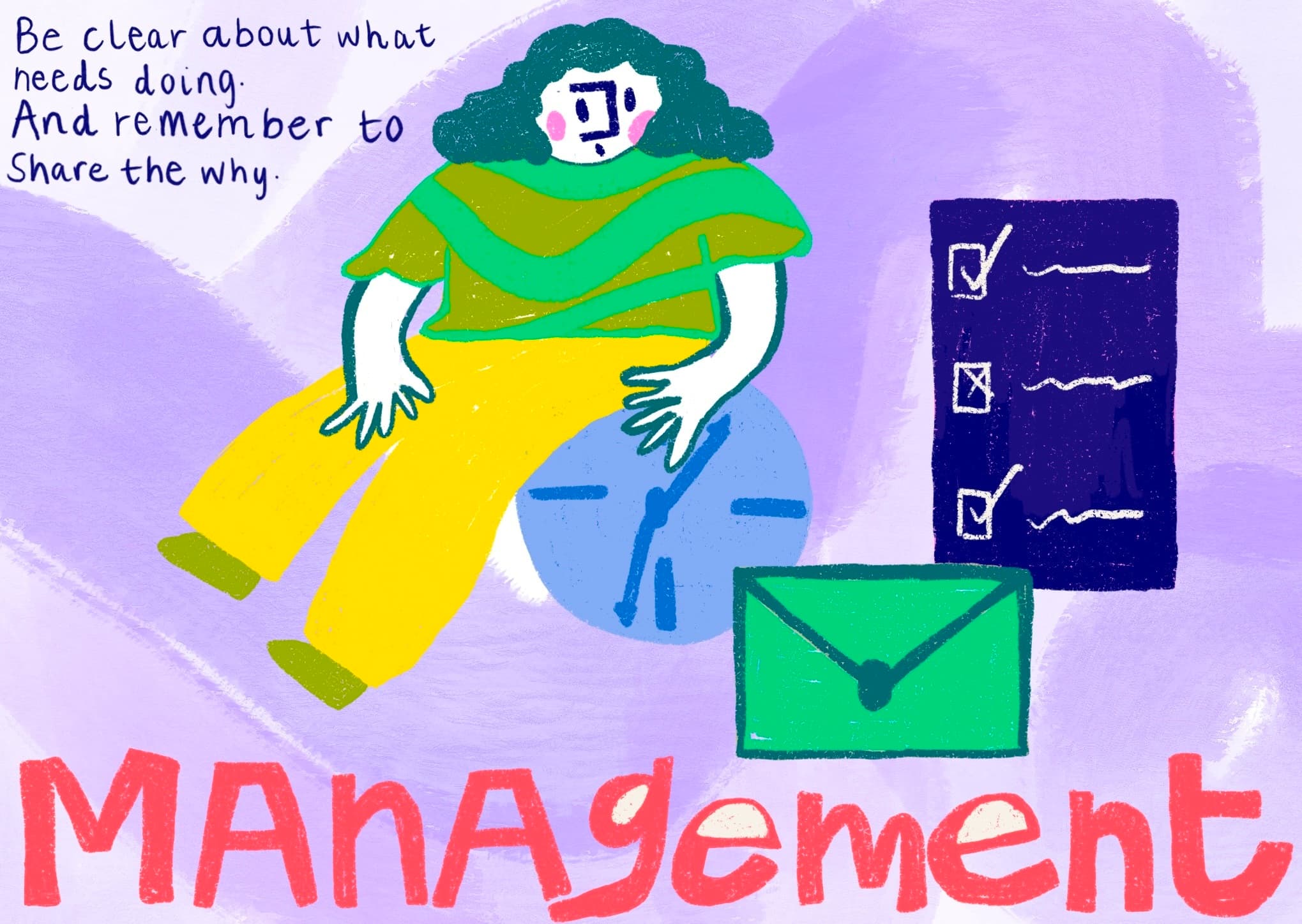
Be Clear About What Needs Doing. And Remember to Share The Why
When you spell out what success looks like, and help people see the whole picture they’re contributing to, it’s exciting and motivating. And collaboration flows.
If you would like a printed version of the entire series, then please contact us on hello@workwiseforscreen.org.uk
In the screen industry, where project timelines are tight and creativity is essential, effective goal setting isn’t a ‘tick box’ exercise, it’s a critical tool to build motivation and drive collaboration among teams.
Research confirms goal setting as one of the most effective organisational interventions, describing it as “prescription-strength medicine” for performance. But like any strong medicine, it needs to be applied correctly. It’s important we go beyond a one-size-fits-all approach and ensure people are clear about actions (what needs doing) and purpose (why it matters) when it comes to setting goals. When you spell out exactly what success looks like and help your team see the whole picture they’re contributing to, you unlock motivation, drive creative focus, and allow collaboration to flow.
Matching The Goal to The Task
Managers often use specific outcome-focused targets wherever they can. These are often labelled ‘SMART’ goals – Specific, Measurable, Achievable (yet stretching), Relevant and Time-bound.
For routine, predictable work, specific and challenging outcome goals work well. They increase focus, motivation and lead to strong results. But research shows that a blanket approach isn’t effective: the type of goal should match the nature of the task. Applying the wrong goal to the wrong task can actually reduce performance by diverting attention from what really matters.
For complex or unpredictable tasks – where people are learning new skills, solving complex problems, or need to work through various stages of related tasks – specific and challenging outcome goals are not the best bet. More effective are behaviour or learning goals. These draw people’s attention to work processes and methods – how they achieve their goals. For example, a goal could be to develop a particular skillset as someone completes a project or follow established teamworking processes. Of course, many creative jobs are complex rather than routine, yet some managers can find this approach counterintuitive, because behaviour and learning goals are often more subjective and harder to assess than outcome goals. But it’s important to understand that for complex tasks, behaviour or learning goals will drive performance much more than emphasising outcomes.
From Intention to Action
Being clear about the task and its purpose still requires a strategy for how this is achieved in practice. To ensure that your team are able to achieve their set goals, focus on these evidence-based steps:
Define implementation goals: Encourage people to go beyond simply stating their goal. It is important to define the specifics (how, where, and when) of what they will do to reach their objective. Research has highlighted that this approach improves our likelihood of achieving goals. For example, an assistant editor aiming to step up to editor on the final season of a TV show might set an implementation goal such as asking to cut one scene on the current production. This goal is time-bound, specific, and clearly demonstrates readiness to progress in their career.
Maintain continuous communication: Effective goal setting relies on monitoring progress and giving timely feedback. Particularly in the fast-moving environment of the screen industry, regular check-ins provide support, remove barriers and enable teams to be adaptive.
Goal setting is a powerful tool, but it should be approached with nuance. Be clear about what success looks like, matching the goal to the complexity of the work. Share the whole picture, explaining the purpose behind each goal. When people have clear and purposeful goals, motivation and collaboration will increase, allowing success to be achieved.
This article is written by Beatrice Rosolin, Research Fellow, Institute for Employment Studies
The Institute for Employment Studies (IES) is an independent, apolitical, international centre of research and consultancy in public employment policy and HR management. It works closely with employers in all sectors, government departments, agencies, professional bodies and associations. IES is a focus of knowledge and practical experience in employment and training policy, the operation of labour markets, and HR planning and development. IES is a not-for-profit organisation.
Sources:
Barends, E., Janssen, B., & Velghe, C. (2016). Rapid evidence assessment of the research literature on the effect of goal setting on workplace performance. London: CIPD
Gifford, J. (2016). Could do better? Assessing what works in performance management. London: CIPD