10 Things You Should Consider Before Creating Your Risk Assessment
A guide for screen industry businesses
If your business’s activities could affect other people (employees, workers, freelancers, contractors, contributors, visitors or members of the public) you must carry out a risk assessment. The Management of Health and Safety at Work Regulations says that assessment must be 'suitable and sufficient', meaning proportionate but thorough enough to identify significant risks and to determine what measures are needed to address them effectively.
The Health and Safety at Work Act 1974 (HSWA) imposes an absolute duty on businesses to ensure, so far as is reasonably practicable, the health, safety, and welfare of all individuals engaged in a project. The Health and Safety Executive (HSE) has sector-specific guidance for film, TV and broadcast (including information sheets covering sports broadcasting, stunts, working at height, electrical safety and vehicles). HSE inspectors may pursue prosecutions where productions have treated safety as an afterthought. Substantial fines make clear that the cost of getting this wrong can be severe.
A risk assessment is a genuine planning tool that protects everyone involved in your production and your business. Here are ten things to think about before you put pen to paper…
Contents:
- 1. Understand what the law actually requires — and who it applies to
- 2. Know the difference between a hazard and a risk
- 3. Think about everyone on or affected by your production, not just employed staff or crew
- 4. Do your reconnaissance and involve the right people
- 5. Apply the hierarchy of controls
- 6. Be specific and create your own risk assessment document
- 7. Consider the full production cycle, including rig, shoot and de-rig
- 8. Consider specific screen sector hazards
- 9. Assign clear responsibilities and make sure people know them
- 10. Review, update and treat it as a living document
Download our example risk assessment, a fictional worked example to illustrate how a small screen production company might approach a risk assessment for a live outside broadcast at a sporting event. All company names, personnel and event details are fictitious. Please note that it is not a substitute for a properly completed risk assessment specific to your production.
1. Understand what the law actually requires — and who it applies to
Risk assessment is a legal requirement under Regulation 3 of the Management of Health and Safety at Work Regulations 1999. The duty falls on every employer, including production companies, in relation to their employees and to everyone else who might be affected by their activities.
If you employ five or more people, the significant findings of your risk assessment must be recorded in writing and the HSE strongly recommends a written record if you employ fewer.
The record is your primary evidence of due diligence if something does go wrong.
The legal duty to manage health and safety cannot be delegated to a consultant; it stays with the employer.
2. Know the difference between a hazard and a risk
A hazard is anything with the potential to cause harm e.g. a trailing cable, a camera platform at height, a piece of electrical equipment in wet weather, an unpredictable crowd.
A risk is the likelihood that the hazard will actually cause harm and how serious that harm might be.
Conflating the two is a common mistakes in risk assessments. Your goal is not to eliminate all hazards (which is often impossible) but to reduce risk to a level that is 'as low as reasonably practicable'.
You should balance the risk against the cost, time and effort involved in controlling it.
Where risk is significant, you must act.
3. Think about everyone on or affected by your production, not just employed staff or crew
Screen productions usually involve a wide range of people beyond those who are employed – creatives, talent, workers, freelancers, contractors, security teams, catering, transport, location owners, members of the public, contributors and even emergency services (if relevant to the production activity).
Your risk assessment/s must consider all of them.
The HSE's guidance on audio-visual production (INDG360) also makes clear that your production company is responsible for ensuring that contractors or freelancers receive adequate information about health and safety arrangements and are formally appointed with your business’s standards clearly communicated to them. Their own risk assessments should feed into yours.
4. Do your reconnaissance and involve the right people
A risk assessment completed remotely, without visiting the location, is rarely adequate. For instance, the HSE's guidance on sports broadcasting is clear that producers must liaise with venue management, event organisers, police and stewards during the planning stage. For any location shoot, a recce by someone competent to identify hazards is essential.
The first AD, the production manager, the location manager and relevant HoDs should be involved early since they will have on-the-ground knowledge of what the risks are and how they can realistically be managed.
5. Apply the hierarchy of controls
When you identify a risk, the question to ask is 'what is the most effective thing we can do?' This hierarchy of controls provides a framework for prioritising your response:
Hierarchy of Controls
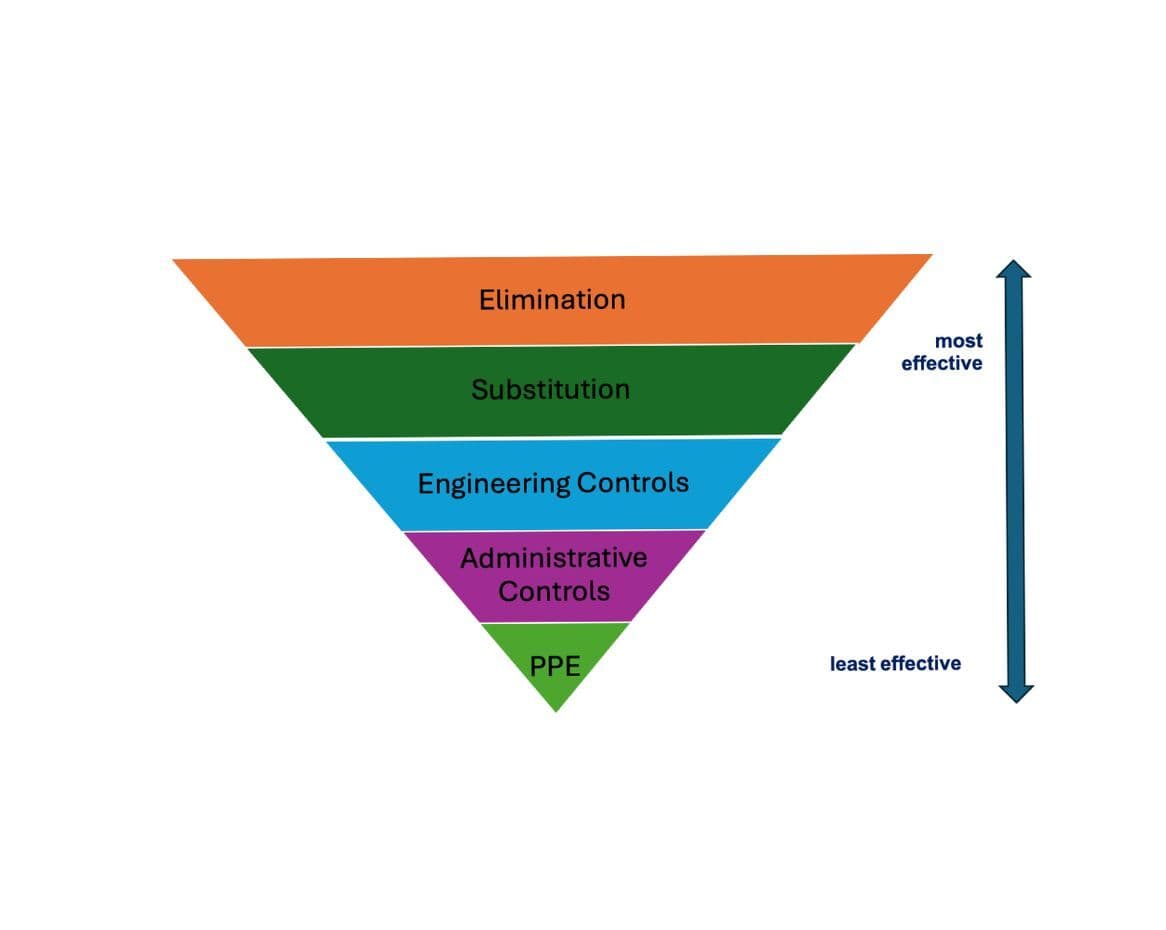
Examples:
- Eliminate (removing the hazard entirely) e.g. Don't build a set element that requires working at height if it can be achieved on the ground.
- Substitute (replacing with something less hazardous) e.g. Use a camera crane instead of sending an operator up scaffolding.
- Engineering controls (physically reducing the risk) e.g. Install guardrails on all elevated platforms; route cables overhead or under matting or tape them down
- Administrative controls (changing how the work is done) e.g. Limit time spent in high-noise environments; brief crew on crowd safety zones
- PPE (protecting the individual) e.g. Hearing protection at loud events; hi-vis for pitch-side crew; hard hats.
NB A risk assessment that relies primarily on PPE, without first considering whether the hazard can be eliminated or engineered out, will not meet the 'suitable and sufficient' standard.
6. Be specific and create your own risk assessment document
A common failure identified in HSE enforcement action against screen productions is the use of generic risk assessments that have not been adapted to the specific activity. Compile your own document to make your 'suitable and sufficient' assessment. An unmodified downloaded template in unlikely to meet this test.
Your own assessment must reflect the actual location, activity, people involved and controls you are putting in place. So a risk assessment for a studio-based production is not the same as one for a live outside broadcast at a sports venue. They may share similar formats but the hazards, those at risk and the controls will differ.
7. Consider the full production cycle, including rig, shoot and de-rig
Risk on a production does not begin when the cameras start rolling and end when they stop. The rig and de-rig phases, when heavy equipment is being moved, cables are being run, scaffolding is being erected or struck, and crew are working late or under time pressure, can be the highest-risk periods of any production.
8. Consider specific screen sector hazards
Screen productions have a distinctive hazard profile. Some of the most significant, each of which has its own HSE guidance in the entertainment sector, include:
- Working at height: camera platforms, gantries, broadcast positions and temporary scaffolding.
- Electrical equipment: generators, power distribution, OB vehicles and equipment in outdoor or wet conditions.
- Manual handling: heavy OB equipment, camera rigs, cable drums and staging.
- Noise: especially at sports events, motor racing, or live music, with potential for hearing damage.
- Slips, trips and cable hazards: one of the most common causes of injury.
- Working with vehicles: camera cars, tracking vehicles, crew transport.
- Crowd behaviour and public disorder: especially relevant for live event broadcasts.
- Fatigue: long shooting days, broken turnarounds and travel time all affect crew safety (Please see our companion article on Working Time Regulations).
9. Assign clear responsibilities and make sure people know them
The HSE's guidance places clear responsibility on a production company to ensure that the significant findings of risk assessments are recorded and communicated to everyone who may be affected. Heads of department should understand what the controls are in their area. Crew members should be briefed before work begins.
Under HSE guidance INDG360, the producer has overall day-to-day responsibility for health and safety standards on a production but responsibility for specific areas can be delegated to HoDs and supervisors, provided they are competent and have been clearly briefed on what is expected of them.
Delegation does not remove the production company's underlying legal duty.
10. Review, update and treat it as a living document
A risk assessment completed at the start of pre-production is not always adequate two weeks into a shoot since circumstances, locations, weather and crew members will change, schedules are compressed, and new hazards emerge. Risk assessments need to be reviewed when there is reason to believe they are no longer valid, or when there has been a significant change.
Fast-moving production environments, especially at live events, mean building in a culture of dynamic risk assessment. Crew members and supervisors should identify and respond to new hazards as they arise.
- HSE Film, TV and broadcasting Information Sheets
- HSE audio-visual production guidance (INDG360)
- HSE Managing risks and risk assessment at work (INDG163)
- Lay-Off and Short-Time Working: What Screen Industry Businesses Need to Know
- Duty of Care: Employing Children and Young Persons
- Duty of Care: Employment in the Screen Sector
- Duty of Care: Engaging Freelancers in the Screen Sector